
You don't need to build an AI system to benefit from AI. But do you know how far AI has actually reached into your work or business? This guide will help you identify your AI maturity, understand four common adopter types and decide on a sensible next step.
TL;DR
Your AI maturity depends on two things: how sophisticated your AI use is and how widely it is used across your organization. Whether you're a Novice, Optimiser, Explorer or Champion, the goal isn't to chase the most advanced tools — it's to choose the next step that best fits your current needs.
The OECD’s 2025 report, AI Adoption by Small and Medium-Sized Enterprises, offers a useful way to understand where your business stands. It identifies four adopter types:
The distinction is not simply how often you use AI. It is how technically complex your applications are and how widely AI is used throughout your organisation.
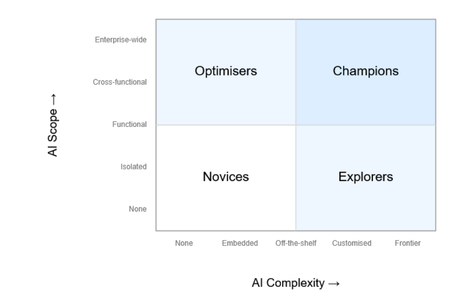
AI Maturity Quadrant: The horizontal axis represents AI Complexity and the vertical axis represents AI Scope. Neither the top-right corner nor the most advanced technology is automatically the right goal for every business.
Use the AI maturity quadrant graphic near the top of this article as your guide. The horizontal axis represents AI Complexity and the vertical axis represents AI Scope. Neither the top-right corner nor the most advanced technology is automatically the right goal for every business.
Two questions that reveal your AI maturity
1. How complex is your AI use?
At the low end, AI may be built into software you already use, or you may use a ready-made chatbot to help with a task. Further along, you customise solutions using your own business data. At the frontier, sophisticated AI systems support critical workflows and decisions. The OECD describes five complexity levels: none, embedded, off-the-shelf, customised and frontier.
2. How broad is your AI use?
Does one employee occasionally use AI, or is it part of the way several teams work? The OECD describes five levels of scope: none, isolated, functional, cross-functional and enterprise-wide. Scope measures how far AI reaches across the business, not how impressive any single application looks.
Your position depends on both dimensions. A sophisticated system used by one team can indicate a different adoption profile from ordinary tools used across an entire business. Digital maturity — including your data practices, staff skills and readiness for change — also shapes how effectively you use AI. The categories are useful profiles, not a rigid ladder.
Typical position: Low complexity; isolated or limited functional use.
Novices may have good digital tools already, but their AI activity is concentrated in a few tasks or people. They generally use built-in features or publicly available tools rather than develop their own systems. Their biggest opportunity is not a complex technology purchase. It is learning to make simple uses reliable and repeatable.
Examples:
- A neighbourhood landscaping company uses a general-purpose AI assistant to turn rough notes into seasonal maintenance reminders. One office employee uses it to draft polite responses to routine enquiries, then checks and edits each message. Scheduling, billing and field operations remain unchanged.
- A small legal-services office uses a built-in transcription feature to create meeting notes, which an employee reviews for accuracy before sharing.
- An independent retailer asks a ready-made chatbot for first drafts of product descriptions, but inventory management and purchasing continue as before.
You might be a Novice if you recognise yourself saying, “I’ve tried AI, but I’m not sure how to make it part of my normal work.”
A useful next move: Pick one recurring, low-risk task. Give the AI clear context and examples, check its work, and measure whether it actually saves effort. Build a repeatable process before adding tools.
Typical position: Relatively low-to-moderate complexity; broad, cross-functional use.
Optimisers use multiple off-the-shelf AI tools across departments. Marketing, operations, administration and customer-facing teams may all benefit. What distinguishes them from Novices is the breadth and growing co-ordination of their work, not the invention of proprietary models.
Some examples:
- A regional home-renovation company uses AI to prepare first drafts of client project summaries, organise supplier quote comparisons, generate staff training outlines and help analyse customer feedback. Team members share approved templates and review procedures. Its tools are commercially available, but AI now supports several functions.
- A small tourism operator uses off-the-shelf AI to support visitor enquiries, translate marketing drafts and help its finance team prepare monthly summaries, with staff checking results.
- A professional-services firm adopts shared AI templates for proposals, onboarding materials and internal training across several departments rather than building its own AI model.
You might be an Optimiser if you say, “Lots of us use AI; now we need consistency and a sensible way to share what works.”
A useful next move: Agree on common practices for privacy, verification, reusable instructions and staff training. Identify where disconnected experiments can become dependable workflows.
Typical position: Higher complexity; narrow or function-specific scope.
Explorers develop or substantially customise AI for a particular problem. They may adapt systems using proprietary data or experiment with agents. Their technical sophistication can be considerable, even while most of the business operates without AI. High complexity does not necessarily mean broad adoption.
Some examples:
- A specialty equipment repair firm works with a developer to create an AI-supported fault-diagnosis assistant trained or configured around its authorised service manuals and historical repair records. Technicians test its suggestions against documented procedures. The system is tailored to one important service function, while sales, finance and HR still use conventional processes.
- A food manufacturer commissions a tailored visual-inspection model to flag packaging defects on one production line; its other departments still work without AI.
- A specialist insurer develops a custom tool to classify a narrow set of incoming claim documents using approved internal examples, while other claims and business functions follow existing processes.
You might be an Explorer if you say, “We have a sophisticated AI solution for one problem, but it has not changed how the rest of the organisation works.”
A useful next move: Evaluate the solution’s accuracy, security, costs and business impact. Explore whether the lessons can transfer to other teams, without assuming every process needs a custom model.
Typical position: High complexity; broad, enterprise-wide scope.
Champions deploy sophisticated AI across much of the organisation. AI helps coordinate operations, inform strategic choices and support business-critical systems. This demands substantial technical, organisational and governance capabilities.
Some examples:
- A national cold-chain logistics provider combines forecasting models, sensor-data analysis and advanced scheduling systems to help plan routes, anticipate equipment failures and manage capacity. Teams in operations, customer service and leadership use connected AI-supported information, with human oversight for consequential decisions.
- A large agricultural co-operative connects tailored forecasting and inventory systems with distribution planning, customer-service information and financial reporting, with staff reviewing important decisions.
- A multi-region healthcare supplier uses advanced, integrated AI-supported systems for procurement forecasts, warehousing, delivery planning and management reporting, backed by specialist monitoring and governance.
You might be a Champion if you say, “AI is woven into our operations and strategy, and we have the specialist teams to manage it.”
A useful next move: Focus on rigorous governance, system resilience, specialist expertise and continuous evaluation. Introductory AI fluency training alone is unlikely to address your main technical challenges.
Find your quadrant: a quick self-check
Understanding the categories is useful. Identifying your own position is better: it can help you decide whether to focus on basic AI skills, expand reliable workflows or seek specialist technical support. HumanSavvy's planned 20-statement self-assessment is designed to make that next step easier.
The assessment follows the OECD’s five complexity levels — none, embedded, off-the-shelf, customised and frontier — and five scope levels — none, isolated, functional, cross-functional and enterprise-wide. Each dimension has 10 concrete, business-oriented statements. Select every statement that accurately describes what you or your organisation routinely do today; do not count things you only plan to try.
After completing the assessment, you'll see your estimated position on the two-axis map and the adopter type that most closely resembles your current use: Novice, Optimiser, Explorer or Champion. You'll also have a clearer starting point for discussing what to improve next. Your results may fall between categories, and different teams can have different levels of maturity. For individuals, Scope is an adaptation of the OECD's organization-level framework.
This self-check is a HumanSavvy educational interpretation of the OECD framework, not an official OECD questionnaire, validated measurement instrument or certification. Your result is a starting point for discussion, not a judgement of your capabilities.
Your next step should fit your starting point
More sophisticated AI isn't necessarily better AI for your business. Your most valuable next step may be learning to ask better questions, verify results, protect sensitive information and turn occasional successes into repeatable work.
HumanSavvy focuses on the people side of AI adoption. We are particularly well placed to help AI Novices — non-technical professionals and teams who want practical confidence and transferable skills. We can also help Optimisers make their AI workflows more consistent and support Explorers with the human skills surrounding specialist projects. AI Champions typically need advanced technical and enterprise support beyond our core training.
AI maturity isn't a competition. It is a way to choose the right next move for your people and your business.
If your team is in the Novice quadrant, begin with one question: What recurring task could we do more confidently and consistently with AI this month? When you're ready to build those skills across your team, explore HumanSavvy's practical, instructor-led AI fluency training.
Source and attribution
Based on OECD (2025), AI Adoption by Small and Medium-Sized Enterprises, especially the taxonomy and its two dimensions, the adopter-category diagram, and the case studies. All business examples in this article are original, fictional illustrations, not OECD case studies or verified outcomes. The planned 20-statement assessment and any scoring are HumanSavvy adaptations, not an OECD-endorsed test.